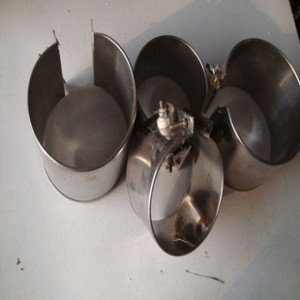

What are the structural design principles of stainless steel heating rings? The editor of the ceramic heating ring manufacturer introduces the main content as follows:
1. When planning the stainless steel heating ring, the effects of thermal expansion, cold contraction, ablation, oxidation, creep, etc. should be considered to avoid deformation and other problems during normal operation.
2. The internal structure of the heating ring should be planned to ensure that the highest temperature in the data selected for the heating ring is not damaged at the highest temperature it may encounter during its processing, and can still operate reliably.
3. The welding structure planning of the heating ring should comply with relevant specifications. The number of welds of the pressure heating ring, especially the parts in the container, should be as small as possible, and the setting of the welds should be easy to inspect.
4. The heating ring shell and its accessories must be planned under pressure according to relevant specifications.
5. The heating ring (including the ends) must be sealed.
6. Corrosive medium heating rings must use corrosion-resistant metal tubes or protective sleeves to ensure the service life of the heating ring.
7. When the shell of the heating ring is made of ordinary steel or other alloy materials with better performance than ordinary steel, its wall thickness shall not be less than 0.35mm. When the shell is made of copper or copper alloy, it must be adapted to the harsh working environment according to the corresponding mechanical strength.
8. The bending radius of the heating ring should be no less than 2.5 times the diameter of the heating ring.
9. To ensure that the inner end of the lead-out rod is on the straight part of the pipe, the heating ring must be zigzag, and the distance between the lead-out rod and the starting point of the zigzag should be no less than 10mm.
10. For two enclosed components with a potential difference greater than 40V, the gap between the enclosed components and the shell and the thickness of the insulating filler should be no less than 1mm, and the distance between the exposed wire and the shell should be no less than 1mm. (Note: If agreed, the above gaps and intervals can be less than 1mm, but it is necessary to strengthen planning and refinement to ensure performance and reliability.)
11. The cross-sectional area of the outlet of the stainless steel heating ring should be no less than 7 times the cross-sectional area of the heating wire.