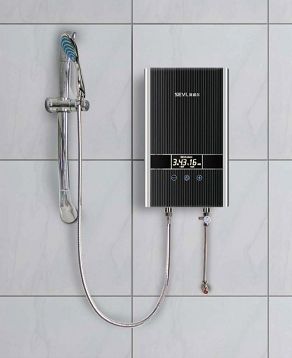
A tankless electric water heater is a type of electric water heater. Unlike storage electric water heaters, it does not require a large storage tank to heat water; instead, it heats water rapidly as it flows through a high-power heating element, providing hot water on demand. Storage electric water heaters use a large tank to resolve the conflict between low heating power and high water usage, while tankless heaters unify these by quickly heating water with high power as it flows in and out.
Features of tankless electric water heaters
Storage electric water heaters have relatively low installation requirements but are bulky; stored water temperature is generally high; heating time is long, sometimes resulting in insufficient or excess hot water, causing waste; to meet different consumer needs, multiple capacities are designed, leading to many models.
Corrosion and scaling of the storage tank's inner liner have always been a prominent issue hindering industry development, especially in areas with poor water quality. Tankless electric water heaters use flow-through heating technology, essentially not requiring hot water storage, so they are compact and lightweight. Their design breaks free from the constraints of large size, offering better aesthetics and fashion. Tankless electric water heaters have high power, fast heating speed, no preheating needed, instant hot water, and are quick and convenient. Since tankless heaters basically have no inner tank, they do not need insulation, resulting in minimal heat loss, energy saving, and electricity efficiency.
Another major advantage of tankless heaters is the low heating water temperature. Taking the well-known brand Greenmus as an example, tankless electric water heaters basically avoid the corrosion problem of water on the heater. Gas water heaters were the earliest type in China. They use gas or natural gas as fuel, burning to generate heat to warm water. Outlet temperature can be adjusted by regulating water flow, and heating speed is generally fast. However, exhaust gases like carbon monoxide and carbon dioxide from gas combustion are directly discharged indoors, easily causing gas poisoning. To prevent such tragedies, gas water heaters have been continuously improved, introducing forced exhaust, flue-type, and balanced gas water heaters. These greatly enhance safety, but installation requires drilling holes in walls for exhaust pipes, which is inconvenient and damages wall aesthetics.
Tankless electric water heaters are simple to install and have significant advantages in aesthetics. However, their power is generally high, imposing certain conditions for use. They require a dedicated copper core line of at least 4mm² and a meter above 20A, preferably with an air switch. Due to these limitations, such heaters are not yet widely adopted.
Additionally, due to low popularity, small production volume, slow market development, costs and unit prices remain high. Competition is less intense than for storage heaters, leading to a mixed market. Some irresponsible companies produce substandard products with instability, rapid power degradation, and short service life.
PS: Each has pros and cons; choose based on your needs. 1. Electric water heater disadvantages: Due to its working principle of heating water in a storage tank via heating elements, it consumes more electricity. The storage tank makes it bulky and space-consuming. Long-term use requires regular descaling to prevent bacterial growth. Additionally, it needs preheating and has limited hot water capacity. Advantages: Compared to gas water heaters, electric ones are cleaner and safer, with fewer installation restrictions—they can be installed anywhere with electricity. Since they don't require separate room installation, temperature adjustment is more convenient. 2. Gas water heater disadvantages: Gas water heaters require separate room installation, making the process more complicated than electric ones. Gas supply implies potential leaks, producing harmful gases that endanger health. Moreover, if the kitchen and bathroom are far apart, gas water heaters may cause slow water flow. They also have high water pressure requirements, so they are not recommended for high-rise buildings. Advantages: Gas water heaters are generally cheaper than electric ones, heat water quickly with stable temperature, are compact in size, and provide unlimited hot water. They are instant-on, requiring no long preheating, and can be used anytime, making them more suitable for larger families.